Dental lead follow-up automation sends the right message to every patient who enquired but hasn't booked: an instant reply, then gentle follow-ups at about day 1, day 3 and day 7, stopping as soon as they book or say no. It's the cheapest way to win more patients from enquiries you already paid to get, through ads, Google or Instagram.
Most enquiries don't book on the first message. People are comparing clinics, waiting for salary day, or just busy. A polite, useful nudge at the right time brings many of them back. Doing that by hand for 50 enquiries a week is where most front desks give up.
Key points
- Reply in seconds, follow up 3 times over about a week, then stop.
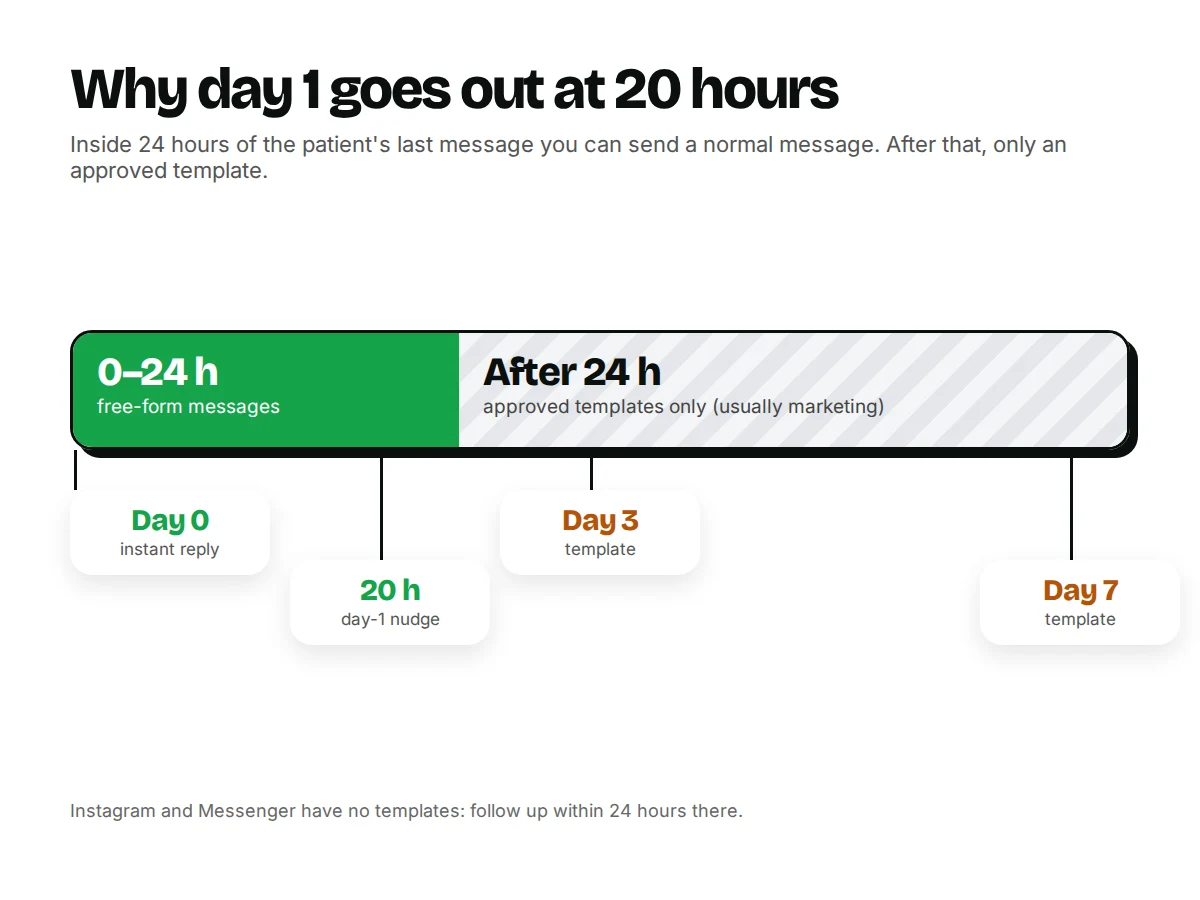
- Send the day-1 follow-up within 24 hours of the patient's last message, so it can be a normal chat message.
- Later follow-ups on WhatsApp need an approved template, and most will count as marketing.
- Every follow-up should add something useful: a price range, a slot, an answer. Never just "Just checking in".
Why do dental enquiries need follow-up?
Because most patients who enquire don't book straight away, and the clinic that stays helpful and visible usually gets the booking.
Patients asking about braces, implants or aligners are making a big, expensive decision. They ask three clinics, read reviews and talk to family. Sales research points the same way: a Harvard Business Review study of 1.25 million leads found that firms that tried to contact leads within an hour were about 7 times more likely to qualify them than those that waited longer. Speed gets you into the conversation. Follow-up keeps you there.
What is the best follow-up sequence for a dental clinic?
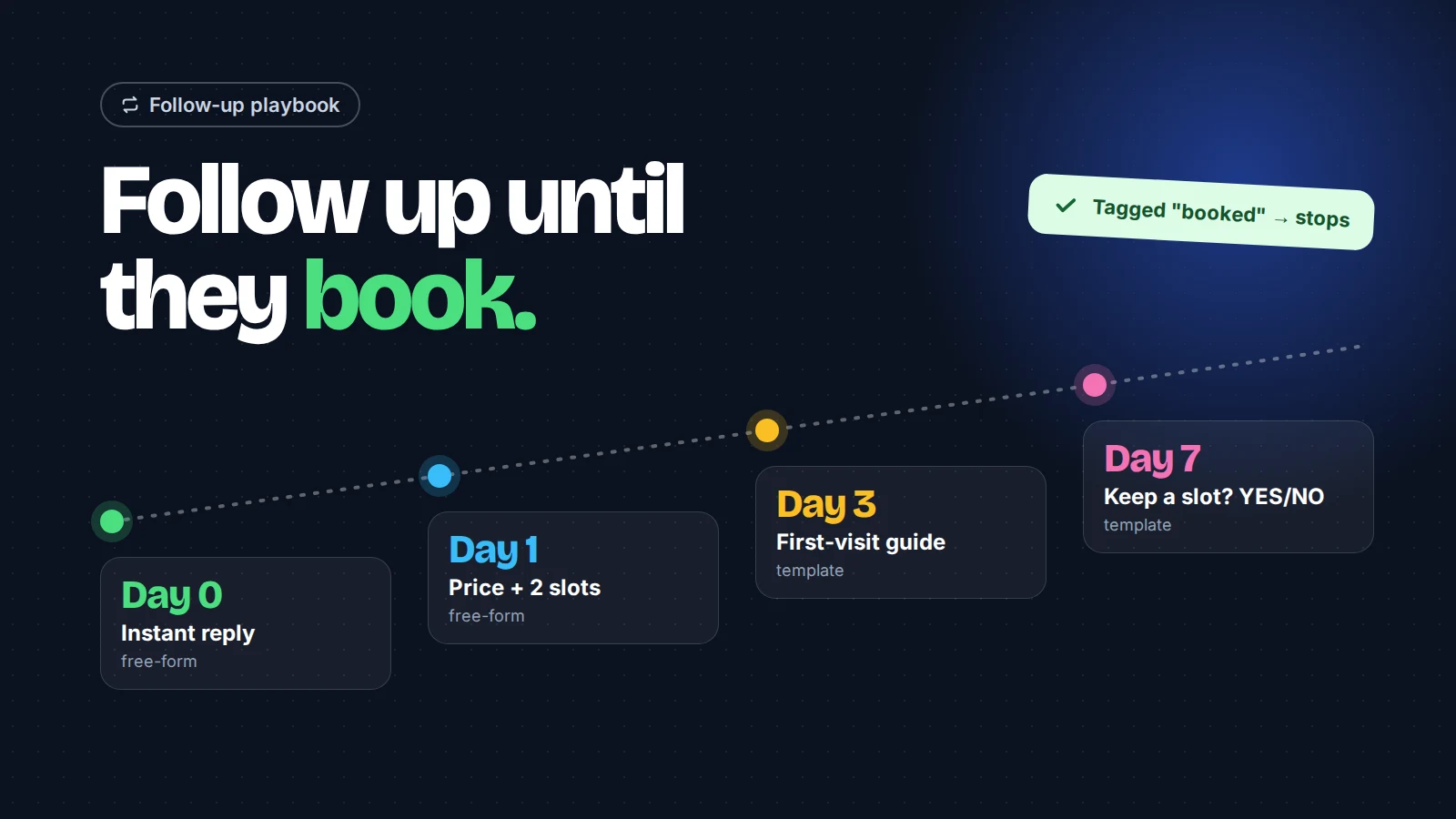
A 4-touch sequence over 7 days works well for most clinics: instant reply, day 1, day 3, day 7. Adjust timing for big treatments, which take longer to decide.
| When | Goal | Message type | Example |
|---|---|---|---|
| Instantly | Answer and start a conversation | Free-form (patient just messaged) | Greeting, timings, buttons: Book · Prices · Talk to us |
| ~20 hours later | Remove the main blocker | Free-form (still inside 24 hours) | Price range + 2 suggested slots |
| Day 3 | Build trust | Template | What the first visit includes, doctor's experience, a review link |
| Day 7 | Last, easy yes/no | Template | "Shall we keep a slot for you this week? Reply YES or NO." |
| After day 7 | Stop | — | Tag no-response. Add to a check-up recall later only if they agreed |
For high-value treatments (implants, aligners, smile design), stretch it: day 1, day 4, day 10, day 21, and offer a free or paid consultation rather than pushing the full treatment.
What should each follow-up message say?
Each message should answer one likely question and make the next step one tap. Here are scripts you can adapt. Names and prices are examples.
Instant reply
Hi Riya 😊 Thanks for contacting Smile Dental. Our clinic is open Mon–Sat, 10 am–8 pm. How can we help? [Book a visit] [Treatment prices] [Talk to the clinic]
Day 1 (inside the 24-hour window)
Hi Riya, following up on your question about teeth cleaning. Scaling and polishing at our clinic usually costs ₹1,200–₹2,000, and the dentist confirms after a quick check. We have slots tomorrow at 11 am or 6 pm. Shall I book one?
Day 3 (template)
Hi {{1}}, if you're still deciding about {{2}}, here's what to expect at your first visit: a check-up with Dr {{3}}, an X-ray if needed, and a clear treatment plan with costs before anything starts. Reply here to book a time that suits you.
Day 7 (template)
Hi {{1}}, shall we keep a slot for you this week at {{2}}? Reply YES and we'll share times, or NO and we won't message you about this again.
The last line matters. It gives the patient an easy way out, which protects your number from blocks and reports.
Which WhatsApp rules affect follow-ups?
Three: the 24-hour window, templates outside it, and opt-in.
- 24-hour customer service window. After a patient's last message you can send normal messages for 24 hours. That's why the day-1 follow-up goes out at about 20 hours. See the 24-hour window explained.
- Templates after 24 hours. Day-3 and day-7 messages must be Meta-approved templates. Meta assigns the category, and follow-ups that encourage a booking are usually marketing. Our template approval guide helps you write ones that pass.
- Opt-in and opt-out. WhatsApp's Business Messaging Policy requires the person's permission to message them and recommends clear opt-out instructions. A patient who messaged you first has started a conversation, but for repeated follow-ups and future recalls, clear consent is safer. Read WhatsApp opt-in.
On Instagram and Facebook Messenger there's no template option. You can only reply within 24 hours of the patient's last message, so do your follow-up inside that window or invite them to continue on WhatsApp.
How do you stop follow-ups when a patient books?
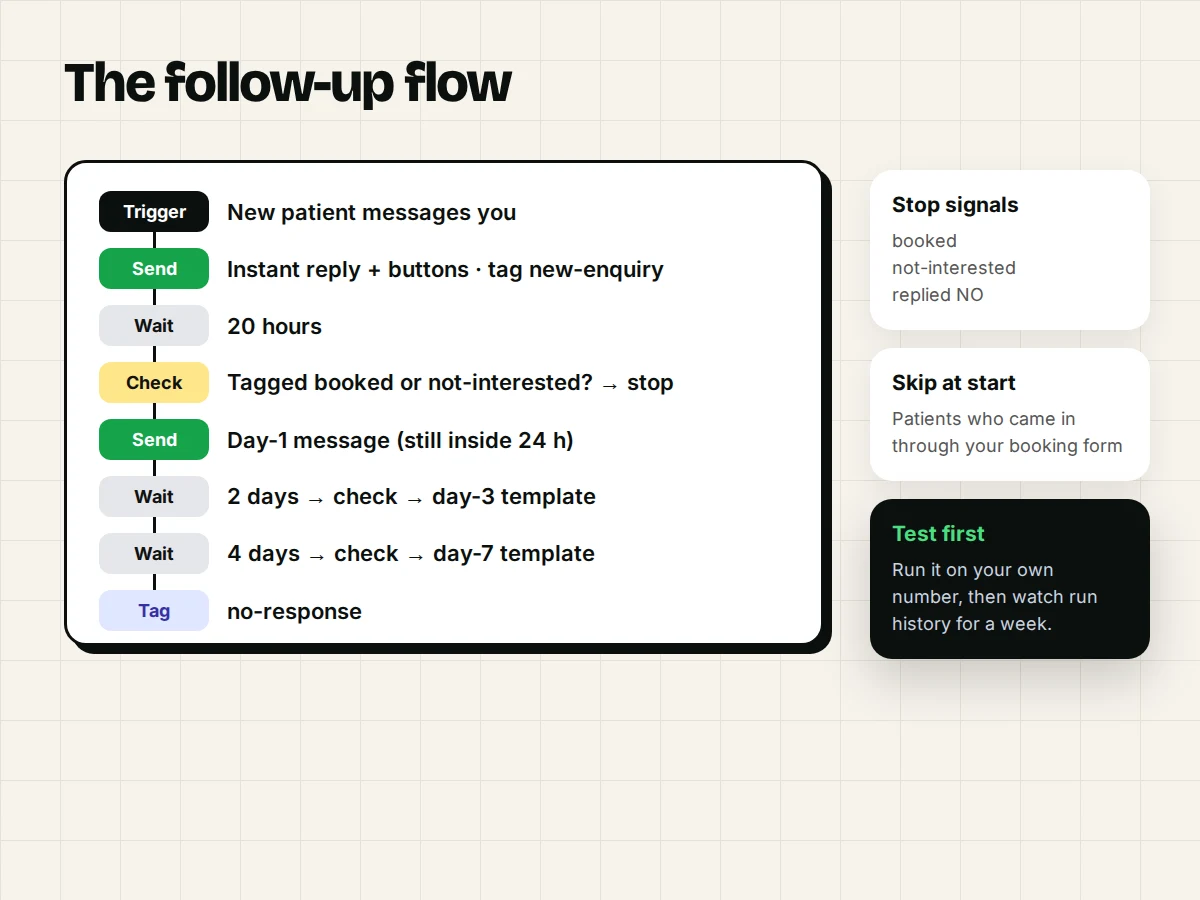
Give the automation a clear stop signal, usually a tag such as booked or not-interested, and check for it before every follow-up.
Nothing annoys a patient more than "Still interested?" the day after they booked. Make it automatic where you can:
- Booking tool → tag. When your online booking tool sends a "booking created" webhook, an automation adds the
bookedtag to that patient. - Front desk → tag. When a booking is made by phone or in chat, the receptionist adds
bookedto the contact. Make it part of the booking routine. - "NO" → tag. If the patient replies NO to the last message, tag
not-interestedand stop.
Also make sure patients who arrive through your booking form don't enter the enquiry sequence at all. A first condition that skips contacts from that source handles it.
How do you build this automation?
One automation with a trigger, waits and conditions, built without code in most WhatsApp automation tools. Here's the shape:
Trigger: new contact (a patient messages you for the first time)
 → If source is "booking form": stop
 → Send instant reply with buttons, add tag "new-enquiry"
 → Wait 20 hours
 → If tag "booked" or "not-interested": stop
 → Send day-1 message (free-form)
 → Wait 2 days
 → If tag "booked" or "not-interested": stop
 → Send day-3 template
 → Wait 4 days
 → If tag "booked" or "not-interested": stop
 → Send day-7 template, add tag "no-response"
Test it with your own number before switching it on, and check the run history daily for the first week.
For the general version of this playbook (lead scoring, routing, other industries), see lead follow-up automation.
What does it cost to follow up on WhatsApp in India?
About ₹0.86 per marketing template and about ₹0.12 per service or utility message to an Indian number, before 18% GST, as of October 2026.
The rates come from Meta's INR rate card as summarised by MyOperator; check Meta's pricing page for current figures. Since 1 October 2026 Meta also charges normal replies at the utility rate (Meta's notice).
Worked example (hypothetical): 200 new enquiries a month, of which 140 reach day 3 and 100 reach day 7.
- Instant replies + day-1 messages: 400 × ₹0.115 ≈ ₹46
- Day-3 templates: 140 × ₹0.8631 ≈ ₹121
- Day-7 templates: 100 × ₹0.8631 ≈ ₹86
- Total ≈ ₹253 + GST a month
If that brings back even one patient for a cleaning, it has paid for itself many times over.
Common follow-up mistakes
- "Just checking in" messages. Each follow-up must add something: a price, a slot, an answer, a reason.
- Following up after a booking. Always check the stop tag first.
- Too many touches. Four over a week is plenty for routine care. More gets you blocked.
- Late-night messages. Schedule follow-ups for daytime. A wait of exactly 20 hours after a 1 am enquiry lands at 9 pm, so review timings.
- Promising outcomes. Don't guarantee results or quote a fixed price for treatment nobody has examined.
- No human backup. When a patient replies, a person should take it from there.
How Omni helps
In Omni you can build this sequence in the no-code automation builder: a contact created trigger (a new patient messaging your WhatsApp number becomes a contact automatically), wait steps, conditions that check a contact's tags or source, free-form WhatsApp messages and approved templates.
Your booking tool can add the booked tag through a webhook-triggered automation. Replies land in a shared inbox for WhatsApp, Instagram and Messenger, and a run history shows where each patient is in the flow. See the Omni for dental clinics page.
Sources
- Harvard Business Review — The Short Life of Online Sales Leads (2011)
- WhatsApp Business Messaging Policy (last updated 23 September 2026)
- Meta — Pricing on the WhatsApp Business Platform
- Meta — Pricing updates for service and utility messages, effective 1 October 2026
- MyOperator — WhatsApp Business API pricing in India 2026
Frequently asked questions
How many times should a dental clinic follow up with an enquiry?
Three follow-ups after the first reply is a good default, for example at day 1, day 3 and day 7. For big treatments like implants or aligners, space them over 2–3 weeks.
Can I follow up on WhatsApp after 24 hours?
Yes, but only with a message template Meta has approved. Inside 24 hours of the patient's last message you can send normal messages.
Should follow-ups be automated or sent by staff?
Both. Let automation send the scheduled nudges and stop them at the right time. When a patient replies, a person should take over the conversation.
What if a patient asks us to stop messaging?
Stop straight away. Tag them so no automation messages them again about it, and update their WhatsApp consent in your records.
Is it worth following up with patients who only asked about the price?
Usually yes. Price is often the first question, not the deciding one. A clear range plus what the first visit includes answers the real worry, which is unexpected costs.
- #dental clinics
- #lead follow-up
- #whatsapp automation
- #patient enquiries
- #conversion
The Omni Team
The Omni team builds the shared inbox, AI chatbots and automation tools businesses use to talk to customers on WhatsApp, Instagram and Messenger.
Put this into practice with Omni
One inbox for WhatsApp, Instagram and Messenger, with AI chatbots, campaigns and automation. Start on the free plan.