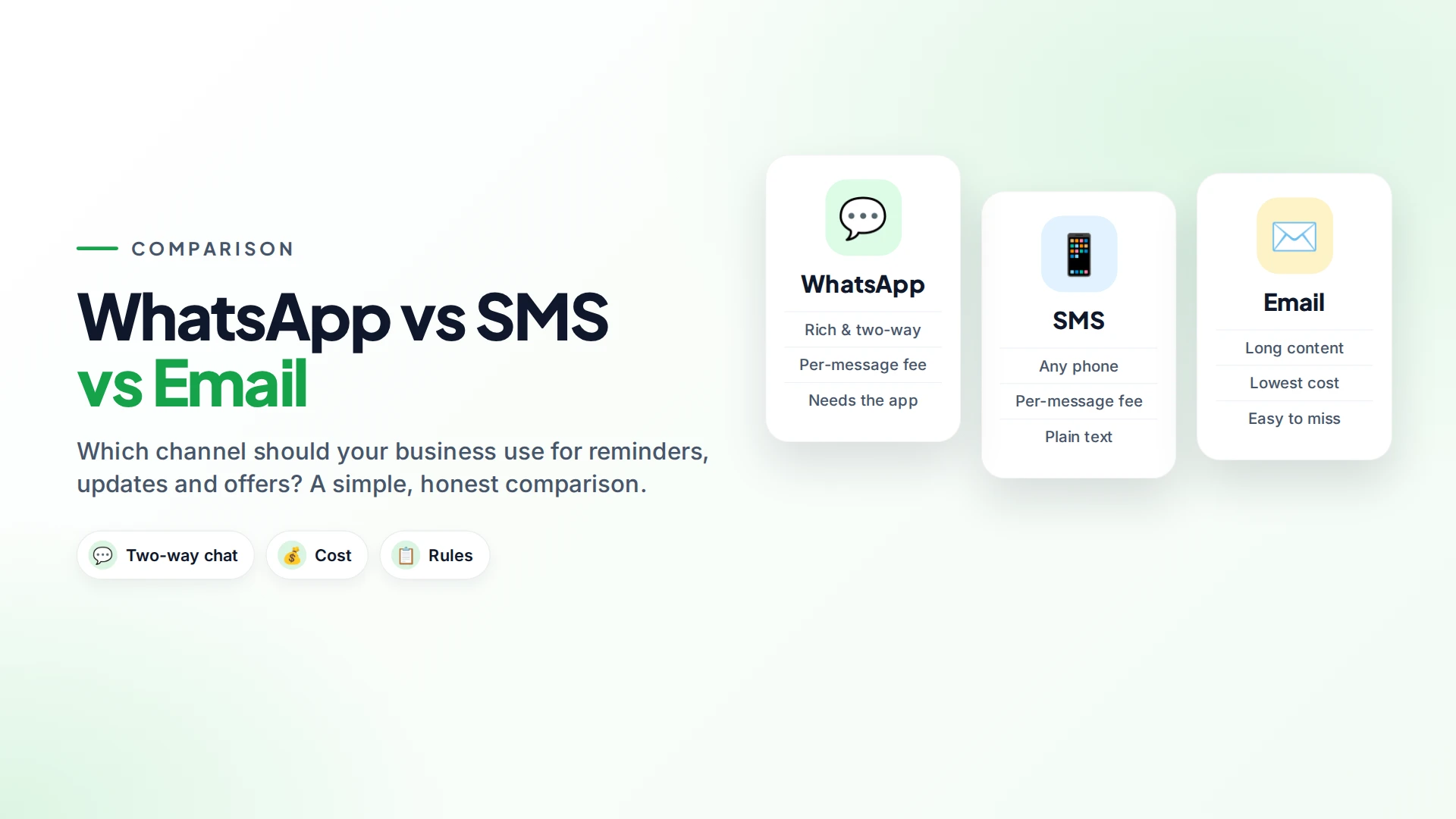
Use WhatsApp for conversations and updates people act on, SMS for short critical messages that must reach any phone, and email for long content, receipts and newsletters. Most businesses get the best results by combining them, each for the job it does best, rather than picking just one.
Here's how they compare in practice, and which to use when.
WhatsApp vs SMS vs email at a glance
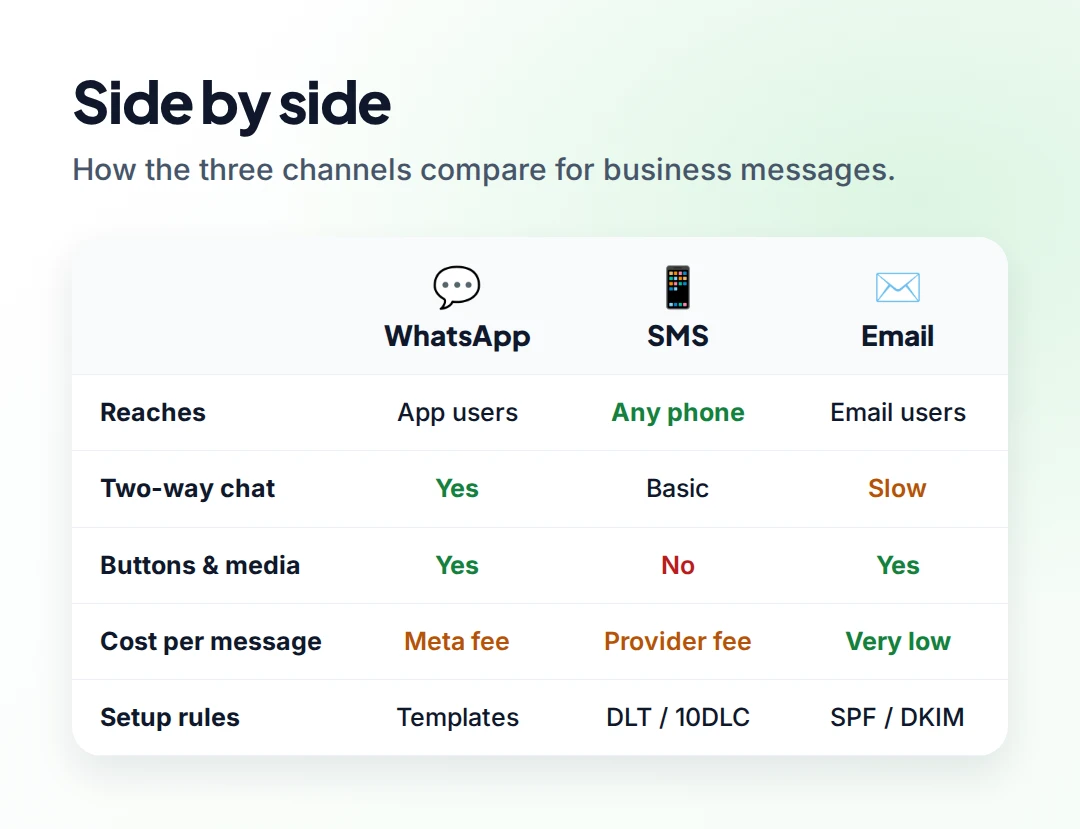
| SMS | |||
|---|---|---|---|
| Reaches | People with WhatsApp installed | Any mobile phone | Anyone with an email address |
| Two-way chat | Yes, rich and natural | Basic text replies | Possible but slow |
| Buttons, images, documents | Yes | No (plain text; MMS in some countries) | Yes |
| Cost per message | Meta charge per template, by country | Provider charge per message | Very low |
| Rules before you start | Approved templates, opt-in | Sender registration in many countries | Domain authentication for good delivery |
| Best for | Reminders, order updates, support, sales chats | One-time codes, urgent alerts | Receipts, newsletters, detailed content |
When WhatsApp is the best choice
WhatsApp shines when you want a reply or a tap:
- Appointment reminders with Confirm and Reschedule buttons. See WhatsApp appointment reminders.
- Order and delivery updates with tracking links. See WhatsApp order notifications.
- Sales conversations where people ask questions before buying.
- Customer support, because the whole history stays in one thread.
Rules: messages you send first must use templates Meta approves in advance, and people must opt in (Meta opt-in guidance). Meta charges per delivered template message by category and country (Meta pricing). From 1 October 2026, replies inside the 24-hour service window are charged too. Our WhatsApp API pricing guide explains how it works.
Weak spot: it only reaches people who use WhatsApp. That's most smartphone users in markets like India, Brazil and much of Europe, but not everyone everywhere.
When SMS is the best choice
SMS works on every mobile phone, with no app and no internet connection needed. That makes it the safest choice for:
- One-time passcodes and login codes.
- Critical alerts where reaching everyone matters more than looks, such as an outage or a closure.
- Audiences who don't use WhatsApp.
Rules: many countries require sender registration. In India, commercial SMS must go through TRAI's DLT system, with your business, sender ID and each message template registered (MSG91 DLT guide). In the US, business texting from standard 10-digit numbers requires A2P 10DLC brand and campaign registration (Twilio A2P 10DLC docs). Unregistered messages can be blocked.
Weak spots: plain text only, a limited number of characters per message, and no buttons.
When email is the best choice
Email is the cheapest channel per message and the best for long or formal content:
- Receipts and invoices people need to keep.
- Newsletters, guides and product announcements.
- Detailed quotes and proposals.
Rules: to reach inboxes, authenticate your domain. Since February 2024, Gmail requires all senders to use SPF or DKIM. Bulk senders (more than 5,000 messages a day to Gmail) need SPF, DKIM and DMARC, plus one-click unsubscribe for marketing email (Google email sender guidelines).
Weak spot: easy to miss. Emails can land in promotions or spam folders, and people often check email less often than chat apps.
Which channel for which job?
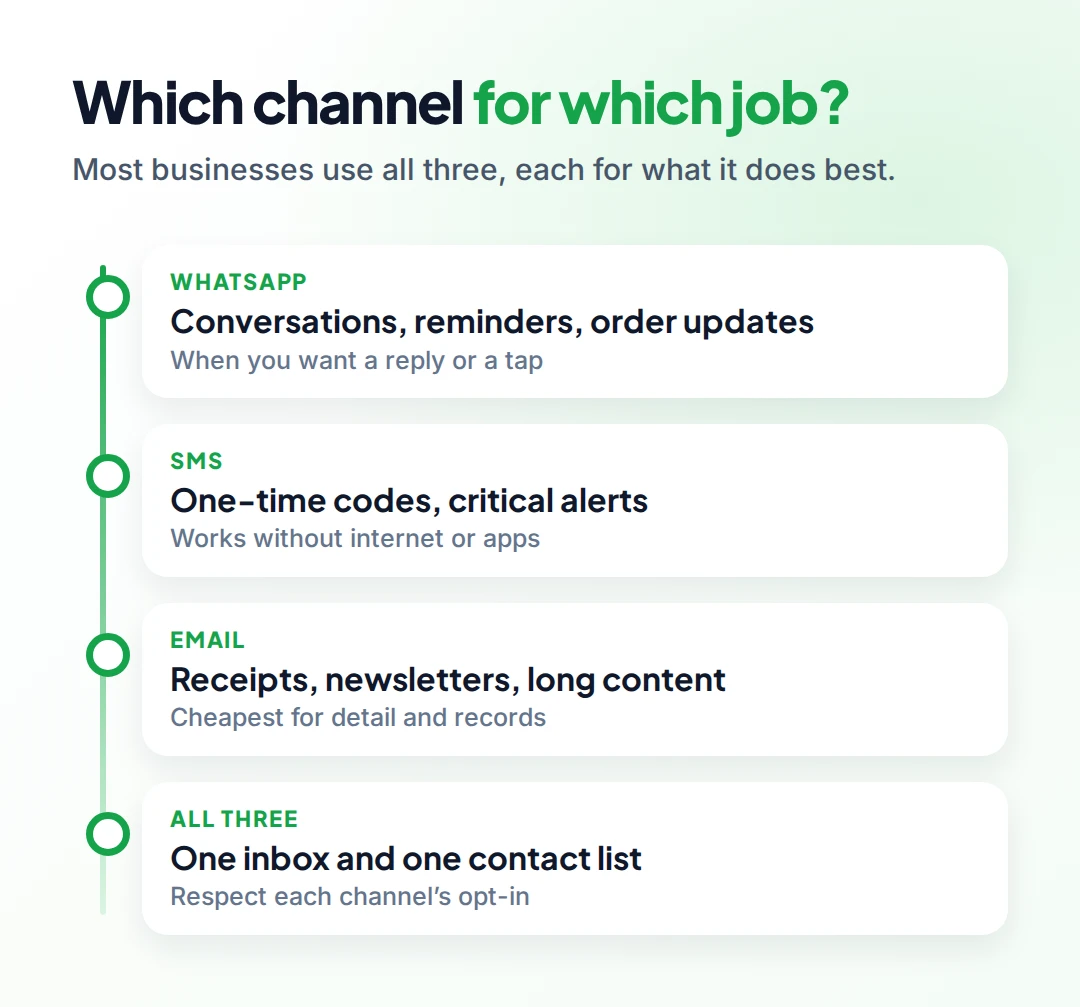
| Job | First choice | Backup |
|---|---|---|
| Appointment reminder | SMS | |
| Order confirmation | Email (receipt) | |
| One-time passcode | SMS or WhatsApp (authentication template) | |
| Monthly newsletter | — | |
| Flash sale to loyal customers | WhatsApp (opted-in) | |
| Service outage alert | SMS | WhatsApp + email |
| Customer support |
How to combine them without annoying people
- One contact list, separate opt-ins. Someone may want order updates on WhatsApp but newsletters only by email. Store opt-in per channel and respect it.
- Don't send the same message everywhere. Pick the best channel for each message, and use another only as a fallback.
- Keep your brand voice consistent across all three.
- Measure per channel: delivered, read or opened, and replied or clicked.
Setting it up with Omni
Omni's campaigns can send over WhatsApp (approved templates), SMS through your own provider, such as Twilio, Vonage, MSG91 or Fast2SMS (SMS provider setup), and email through your own SMTP server (email setup). All three use one contact list with per-channel opt-in, and contacts who haven't opted in to a channel are skipped automatically. Automations can send on all three as well.
Two-way conversations happen in the team inbox, which covers WhatsApp, Instagram and Facebook Messenger. SMS and email are for sending campaigns and automated messages, not inbox chats.
Sources
Frequently asked questions
Is WhatsApp better than SMS for business?
For conversations, reminders and updates with buttons or media, usually yes. SMS is better when you must reach every phone, including people without WhatsApp or internet access, such as for one-time codes and critical alerts.
Which is cheaper: WhatsApp, SMS or email?
Email is usually the cheapest per message. WhatsApp and SMS both charge per message, and the rates vary a lot by country and message type, so compare them for the countries you message.
Do I need permission to send WhatsApp, SMS or email marketing?
Yes. WhatsApp requires opt-in, and most countries have marketing and privacy laws covering SMS and email. Collect consent per channel and make it easy to opt out.
Can I use all three channels from one platform?
Yes, many messaging platforms let you send campaigns over WhatsApp, SMS and email from one contact list, with separate opt-ins for each channel.
What is DLT registration for SMS?
In India, TRAI requires businesses sending commercial SMS to register their business, sender IDs and message templates on a DLT platform. Unregistered messages can be blocked.
- #whatsapp vs sms
- #email marketing
- #sms marketing
- #business messaging
- #customer communication
The Omni Team
The Omni team builds the shared inbox, AI chatbots and automation tools businesses use to talk to customers on WhatsApp, Instagram and Messenger.
Put this into practice with Omni
One inbox for WhatsApp, Instagram and Messenger, with AI chatbots, campaigns and automation. Start on the free plan.